Ectropion & Entropion Surgery


Reclaiming Eyelid Health
When lower eyelids begin to sag outward away from the eye or roll inward against the delicate surface of the cornea, daily life becomes increasingly uncomfortable. Misaligned eyelids leave your eyes vulnerable to severe dryness, chronic watering, redness, and painful corneal irritation. When structural eyelid changes threaten your eye health or vision, specialized oculoplastic care is essential.
At Schlessinger Eye and Face in Woodbury, NY, correcting eyelid malpositions requires precise anatomical expertise. Board-certified oculoplastic surgeon Dr. David A. Schlessinger brings over 30 years of subspecialty care to patients across Long Island. Dr. Schlessinger gently repositions affected eyelids to restore natural lid closure, eliminate irritation, and protect your long-term vision.

Subspecialty oculoplastic surgical repair designed to tighten, reposition, and stabilize lower eyelids that turn outward (ectropion) or inward (entropion).
Outpatient procedure typically lasting 30 to 45 minutes per eyelid under local anesthesia with light sedation.
Eliminates ocular pain, redness, and foreign body sensations; prevents corneal scarring; restores proper tear drainage; and re-establishes natural eyelid contour.
Recovery involves 7 to 10 days of mild swelling and bruising; functional eye relief and comfort improvements are noticeable immediately following healing.

Precision Oculoplastic Care
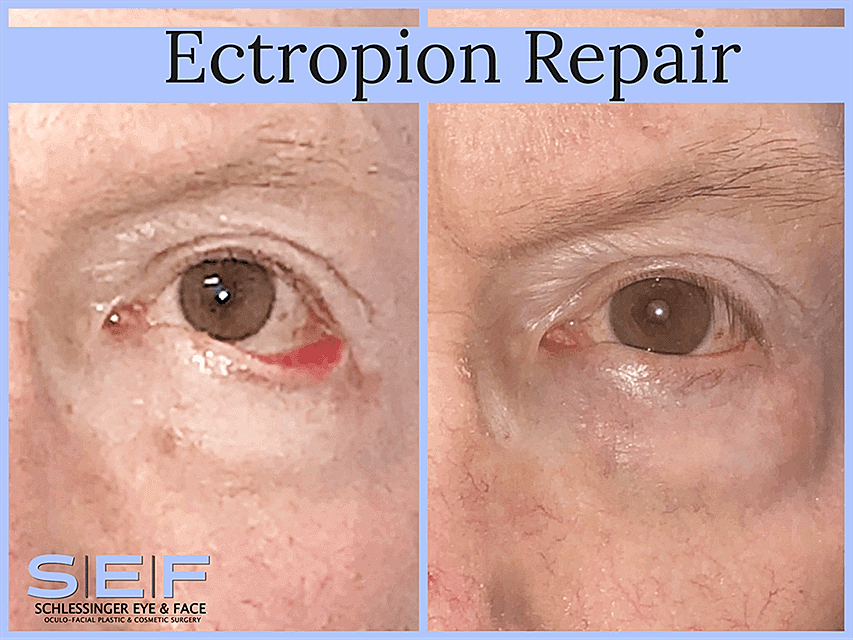
Ectropion is a medical condition in which the lower eyelid turns outwards. Ectropion is typically seen in older individuals as a result of senescence, that is, the breakdown of tissues caused by aging. It is also one of the notable features of newborns exhibiting Harlequin type ichthyosis. Ectropion most commonly affects the lower eyelids. The condition can be repaired surgically.
Mild cases of ectropion can cause tearing, redness, and discomfort of the eye. More severe or chronic cases of ectropion can cause recurrent infections, chronic conjunctivitis, and corneal decompensation. If left untreated, ectropion can result in vision loss from corneal scarring, and in very severe cases corneal ulceration and even endophthalmitis and loss of the eye may occur.
Entropion is a medical condition in which the eyelids fold inward. It is very uncomfortable, as the eyelashes rub against the cornea constantly. Entropion is usually caused by genetic factors and may be congenital. Untreated entropion can cause eye irritation, tearing, infections, and corneal disease.
Balancing Function, Comfort, and Aesthetics
Your procedure is thoroughly planned during a private consultation with Dr. Schlessinger in our Woodbury office.
On the day of your outpatient surgery, our team ensures you feel completely relaxed. Local anesthesia combined with light intravenous sedation is administered to make the procedure pain-free and comfortable.
Most surgical treatments for ectropion involve tightening the tendons of the eyelid. Surgery is usually done on an outpatient basis under sedation. Healing is generally quick, with a return to normal activities within 10 days or so.
Surgical treatment for entropion involves removing excess skin of the outer lids. The prognosis is excellent if surgery is performed before the cornea is damaged.
Dr. Schlessinger's surgical technique focuses on restoring proper function and comfort, as well as delivering a balanced cosmetic appearance.
Reverse Age-Related Lid Laxity
Ectropion and entropion repair help relieve painful symptoms and complication risks caused by improper lid position:
Prevents inward lashes from scratching the cornea during entropion.
Restores tears to their natural drainage pathways by realigning the lower lid margin during ectropion.
Eliminates dry, inflamed tissue exposure caused by outward-turning lower lids.
Reduces exposure risks and chronic bacterial accumulation along misaligned lid margins.
Reconstructs lower lid support for patients recovering from Bell's palsy or facial nerve weakness.

Proper Tear Drainage & Essential Corneal Health
Protects Long-Term Vision and Corneal Health
Properly aligning the lower eyelid prevents recurring corneal ulcers, scarring, and permanent visual loss caused by mechanical scraping or chronic atmospheric exposure.
Restores Daily Eye Comfort
Eliminates persistent pain, burning, redness, and the foreign-body sensation caused by misaligned lid margins and inverted eyelashes.
Normalizes Tear Distribution and Drainage
Ectropion repair places the tear punctum back against the eye surface, allowing tears to drain properly into the tear duct rather than overflowing onto your cheek.
Natural, Balanced Cosmetic Alignment
Dr. Schlessinger restores firm, youthful lower eyelid contours that blend seamlessly into your facial features without looking tight or unnatural.
Candidate Eligibility
You may be an ideal candidate for surgery if you experience an outward-sagging or inward-rolling lower eyelid, persistent eye watering, severe dryness, or constant irritation from eyelashes touching your eye. Ideal candidates are in good overall health and desire lasting functional relief.
During your consultation, Dr. Schlessinger evaluates your lower lid laxity, tear production, and corneal health. Patients with temporary surface inflammation will receive lubricating ointments or protective measures prior to surgery.

Lasting Eye Relief

Recovery after eyelid alignment surgery is straightforward. Most patients experience minimal discomfort, which is easily managed with mild pain relievers and cooling eye compresses.
Avoid rubbing your eyes, wear dark sunglasses outdoors, and refrain from strenuous exercise or heavy lifting for 2 weeks. Apply prescribed antibiotic eye drops or lubricating ointments as directed to protect the healing lid margin.
Days 1–3: Bruising and swelling peak early. Apply cloth-wrapped cold packs for 10 to 15 minutes at a time to keep swelling minimal.
Days 7–10: Suture removal takes place at our Woodbury office. Most swelling and bruising resolve by this time.
Functional relief from eye pain, friction, and tearing is noticeable immediately once the initial post-procedure swelling resolves. As your lower eyelid heals over 2 to 3 weeks, the lid margin rests securely against the eyeball, providing complete protection and comfort.
Because Dr. Schlessinger tightens the underlying structural tendons and muscles, surgical corrections are long-lasting, restoring both function and appearance.
Trust 30 Year of Oculoplastic Expertise
Correcting delicate eyelid malpositions demands a master-level understanding of eyelid physics, tear drainage dynamics, and corneal protection. As a board-certified physician fellowship-trained in oculoplastic surgery, Dr. David A. Schlessinger brings over 30 years of subspecialty excellence to every procedure.
At Schlessinger Eye and Face in Woodbury, NY, your surgical care is completely physician-led.
Take the first step toward lasting eye comfort and protection. Contact Schlessinger Eye and Face in Woodbury to schedule your personal consultation with Dr. Schlessinger today.
Leaving eyelid malpositions untreated can lead to severe eye complications. Entropion can cause corneal scratches, infection, and permanent corneal scarring from rubbing lashes. Ectropion can cause chronic dry eye, exposure keratitis, thickened, inflamed lid lining, and constant tear overflow.
Lubricating drops and eyelid taping provide temporary relief by protecting the eye surface, but they do not fix the underlying structural muscle or tendon laxity. Surgery is the only definitive cure for ectropion and entropion.
Because these procedures are medically necessary to correct functional impairment and protect vision, they are typically covered by health insurance plans. Our Woodbury team will help evaluate your insurance coverage during your consultation.
Incisions are placed discreetly along the natural eyelid crease, below the eyelash line, or at the outer corner of the eye. Once fully healed, scars fade into fine lines that are virtually imperceptible.
No. The procedure is performed under local anesthesia with light sedation, ensuring you remain completely pain-free. Post-procedure discomfort is minimal and easily controlled with cold compresses and mild pain medication.
“I couldn't be happier with the outcome.”